The studies on the table
GHK-Cu research: the results don’t all agree
A real result can be narrower than its reputation. The skin papers, the hair trial and the wound materials each make a different case.
Copper peptide skin research has a promising, small record
The 2015 skin-regeneration review describes small topical trials reporting improvements in skin density, firmness, fine lines and wrinkle depth. It also reports increased collagen production in 70% of treated women, compared with 50% for vitamin C and 40% for retinoic acid.
That is a human signal, and I don’t dismiss it merely because the trials are small. The job assigned to those figures worries me more: they do not establish the performance of every formulation, and they cannot be turned into an individual’s odds of getting a desired change. The numbers refer to the reported collagen response.
Much of the foundational literature comes from Loren Pickart and colleagues, as the skin and gene-data reviews make plain. A claim repeated across reviews still needs replication by another team. Broader gene-expression and anti-aging claims still have limited replication outside that originating group.
Copper transport through donated human skin
Hostynek’s donated-human-skin study reported a permeability coefficient of 2.43 ± 0.51 × 10^-4 cm/h. Over 48 hours, 136.2 ± 17.5 µg/cm² of copper permeated the dermatomed skin and 97 ± 6.6 µg/cm² was retained as a dermal depot. The experiment measured donated skin in the laboratory; serum performance on a living face remained unmeasured.
The measured substance was copper. I won’t substitute “intact GHK-Cu reached its target” for that finding. The 2025 anti-wrinkle review treats delivery through the outer skin as a central problem and discusses modified peptides and delivery approaches. Changing delivery may change the experiment; an ingredient name does not make the formulations interchangeable.

The cream was liked more. Redness was not measurably better.
In Miller’s randomized trial after CO2 laser resurfacing, 13 patients were studied. The topical copper tripeptide complex produced no statistically significant objective difference in redness compared with control, while patient satisfaction was significantly higher in the GHK-Cu group, with p=0.04.
I let the favorable satisfaction result carry too much of the argument at first. The objective endpoint brings the claim back down to size. Enjoying a cream is a real subjective outcome; it does not establish a reduction in redness or faster repair. This awkward paper deserves a place beside the encouraging ones because it changes the account of copper peptide benefits.
Copper peptide hair growth: the combination gets the credit
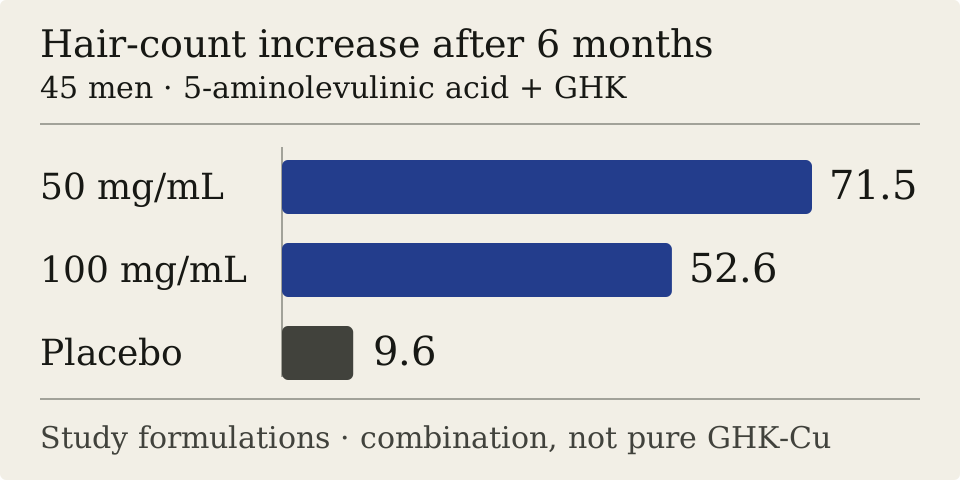
The 2016 controlled hair trial enrolled 45 men with androgenetic alopecia and followed a topical complex of 5-aminolevulinic acid and GHK for 6 months. The reported hair-count increases were 52.6 with the 100 mg/mL study formulation, 71.5 with the 50 mg/mL formulation and 9.6 with placebo. No adverse events were reported in any group. These concentrations describe only the trial’s formulations; they offer no directions for use.
My objection concerns credit. The trial tested a combination containing GHK, not pure GHK-Cu, so the gain cannot be assigned to GHK-Cu alone. Nor does the larger reported count in the lower-strength group establish a general rule about concentration.
Earlier copper-peptide hair work used C3H mice. It is relevant background, but it does not fill the missing equivalent human trial of pure GHK-Cu. A neat hair-regrowth claim would have to leave out either the species or the other ingredient.
A wound dressing is an experiment of its own
The wound literature includes more than adding GHK-Cu to an existing cream. Arul’s biotinylated-GHK collagen matrix accelerated dermal wound healing in rats. The later nanofiber hydrogel study involved mouse wound models and human dermal fibroblasts in culture, with accelerated wound healing and densely remodeled collagen in the animal work.
Those results depend on the peptide form and the material delivering it. I regard the materials work as inventive, but the dressings and a plain peptide preparation require separate evidence, and a human wound treatment remains unestablished by the animal outcomes. The broader tissue-remodeling review gathers encouraging repair findings across models without erasing those differences.
Copper peptide vs retinol: read the comparator’s name
The 2025 review’s collagen comparison reports 70% for GHK-Cu, 50% for vitamin C and 40% for retinoic acid. Retinoic acid is the named comparator in that report; replacing it with “retinol” blurs the result behind the search question.
Direct comparisons are limited, and a collagen-synthesis endpoint does not decide every question about wrinkles, irritation or a particular formulation. I cannot award a winner on that table alone. A matched trial measuring the same outcomes would be a more satisfying answer.